Explain the Difference Between a Galaxy and the Universe
- Our Sun is just one Star in the Milky Way Galaxy. - We live on planet Earth which is part of our local Solar System.

Comparison Of The Entire Universe From The Smallest Dwarf Planets To Planets To Stars To Nebulas To Galaxies And T Galaxies Milky Way Galaxy Dwarf Planet
Difference between Heliocentric and Geocentric Models of the Universe.

. The ages of the universe our galaxy the solar system and Earth can be estimated using modem scientific methods. In the case of a Doppler shift the only thing that matters is the relative velocity of the emitting object when the light is emitted compared to that of the receiving object when the light is received. Large system of stars held together by mutual gravitation and isolated from similar systems by vast regions of space.
Galaxies tend to cluster together within the Universe. What is the difference between and E7 and an S0 galaxy an E7 is very elongated whereas an S0 would be more round Explain how the rotation curve method of finding a galaxys mass is similar to the method used to find the masses of binary stars. The notion of the expanding universe also helps explain why our night sky is dark and how this ties in with the observable universe.
The totality of known or supposed objects and phenomena throughout space. For example we cannot currently see the outer edges of our Universe but some day we may be able to. The Milky Way is big but some galaxies like our Andromeda Galaxy neighbor are much larger.
6 pts Kinematic and Cosmological Red shifts a 2 pts Explain the difference between kinematic and cosmological red- shifts. A satellite is something orbiting another body. The universe we live in that originated with the Big Bang that occured about 137 billion years ago and is currently estimated to be commprised of between 100 and 400 billion galaxies.
Constellation is a collection of only a few stars. The term universe refers to everything that exists including galaxies and the space between them. A galaxy is a massive cluster of stars millions or billions held together by gravity.
In general our Universe is seen as being either the shape of a sphere traditionally or a. The universe is all of the galaxies and other objects that we know of. A Universe is everything which has been and will be observable from a certain point.
Answer 1 of 18. As viewed from Earth galaxy A is at redshift zA-1 and galaxy B is at zB 9 What is the redshift of galaxy B as measured by a hypothetical observer on galaxy A. There is a resemblance of human beings or animals when stars in the constellation are arranged.
There are billions of galaxies in the Universe. In this analogy we picture the universe as a gigantic blob of dough which is placed in an oven and begins to expand. Our galaxy is one of billions in the universe each of which in turn contains billions of stars.
The age of the universe can be derived from the observed relationship between the velocities of and the distances separating the galaxies. - The Milky Way Galaxy is just one Galaxy in the Universe. So to sum it up.
We live roughly half way between the centre and. There are many artificial satellites orbiting around Earth. The Milky Way measures about 100000 light-years across and is thought to contain 200 billion stars.
It is thought that most if not all galactic cores contain a supermassive black hole. Show students on the Inflatable Celestial Globe the difference between a star and a galaxy by using the following example. NASAs telescopes allow us to study.
The universe is flat and is composed of 46 atoms 24 cold dark matter and 714 dark energy. The main difference between space and universe is that space refers to the void between celestial objects whereas universe refers to the entirety of all physical matter and energy solar systems planets galaxies and all contents of the space. The word universe should be interpreted as our Universe ie.
Galaxy is collection of billions of stars. Practically speaking the difference between the two Doppler redshift and cosmological redshift is this. A galaxy is a large number of stars orbiting about a central core.
The Milky Way is the name of the galaxy in which we live. The velocities of distant galaxies can be measured very accurately but the measurement of. Galaxies come in many sizes.
Similarity- All the galaxies in the universe contains stars asteroidsplanets and galactic cloud. Basically SIZE is the biggest distinction. Summary Space vs Universe.
The analogy for the universes expansion which I prefer is the dough and raisins analogy which has been around at least since Martin Gardners 1962 book Relativity for the Million if not earlier. The geocentric and heliocentric mdoels of the universe are historical methods of understanding the universe by assuming respectively that the Earth is at the centre of the known universe geocentrism and that the Sun is at the centre of the universe heliocentrism with. Our galaxy was referred to as the universe before it was discovered that there were other galaxies.
The universe is all of the galaxies billions of them. Difference- They differ in the shapes where some are elliptical some are spiral and some are even irregular. For example two companion galaxies to our Milky Way galaxy are.
Resembling human beings or animals. A galaxy is a large collection of stars gas and dust kept together by gravity. Visible galaxies are less comparativey with our naked eyes.
- Our Solar System includes the Sun and everything that orbits the Sun. Thus it can be surmised that space is a part of the universe. On that scale with our Solar System in your hand the Milky Way Galaxy with its 200 400 billion stars would span North America see the illustration on the right.
C 2 pts When. Galaxies come in.
24 Pictures That Are Going To Make You Feel Very Very Small Space Facts Astronomy Facts Space And Astronomy
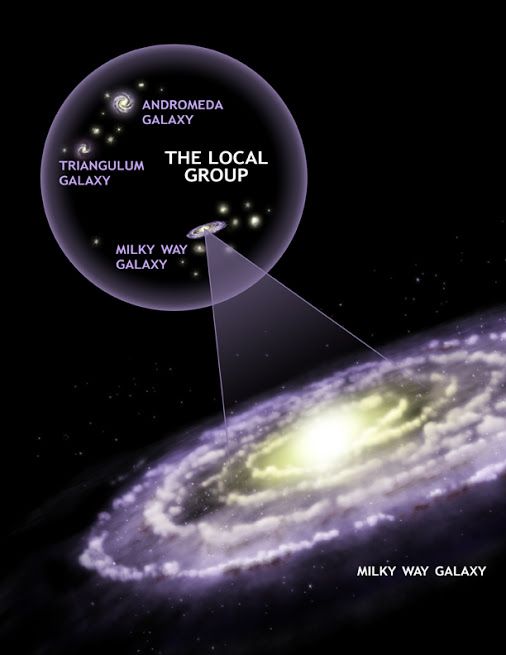
Where Is Our Galaxy In The Universe Earthsky Org Andromeda Galaxy Milky Way Astronomy

Relative Size Of Universe Galaxy Solar System And The Planets Planetary System Space And Astronomy Galaxies


Comments
Post a Comment